We present an efficient B-spline finite element method (FEM) for cloth simulation. While higher-order FEM has long promised higher accuracy, its adoption in cloth simulators has been limited by larger computational costs while generating results with similar visual quality. Our contribution is a full algorithmic pipeline that makes cloth simulation using quadratic B-spline surfaces faster than standard linear FEM in practice while consistently improving accuracy and visual fidelity.
Using quadratic B-spline basis functions, we obtain a globally C1-continuous displacement field that supports consistent discretization of both membrane and bending energies, effectively reducing locking artifacts and mesh dependence common to linear elements. To close the performance gap, we introduce a reduced integration scheme that separately optimizes quadrature rules for membrane and bending energies, an accelerated Hessian assembly procedure tailored to the spline structure, and an optimized linear solver based on partial factorization.
Together, these optimizations make high-order, smooth cloth simulation competitive at scale, yielding an average 2× speedup over linear FEM. Extensive experiments demonstrate improved accuracy, wrinkle detail, and robustness, including contact-rich scenarios, relative to linear FEM and recent higher-order approaches. Our method enables realistic wrinkling dynamics across a wide range of material parameters and supports practical garment animation, providing a new promising spatial discretization for high-quality cloth simulation.
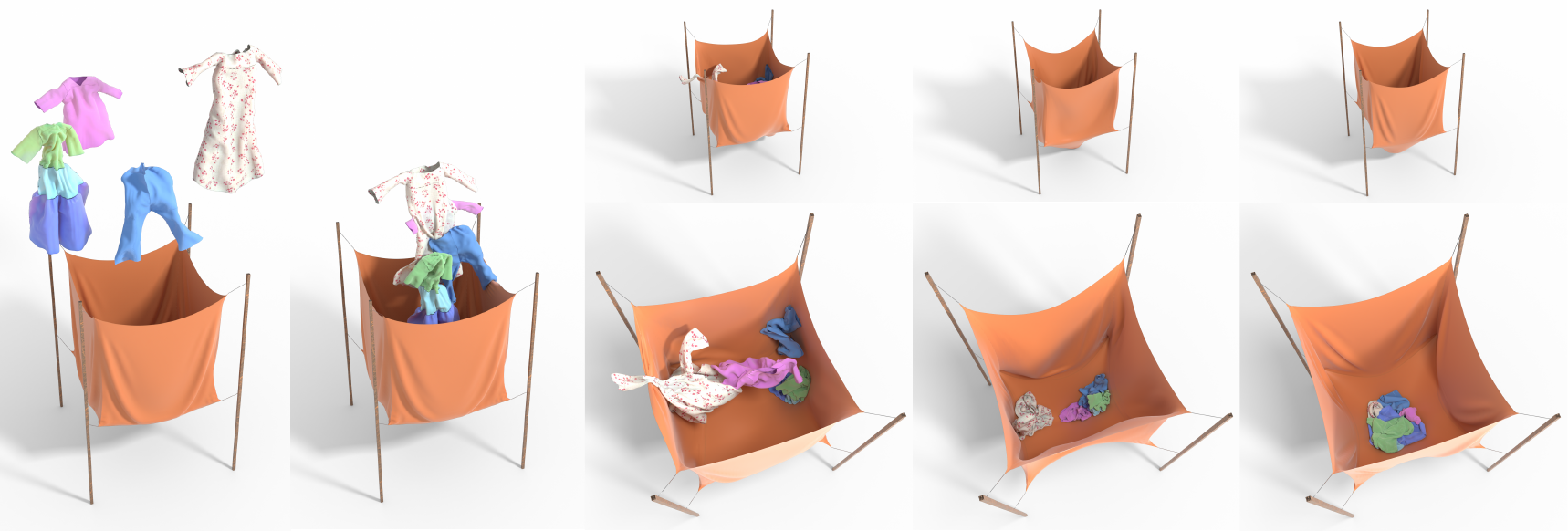
We stress-test the method through scaling and contact-rich configurations on both rectangular and non-rectangular meshes — fast-spinning sphere contact, oblique helicopter impact, dense stripe contact on an articulated armadillo, full-character garment animation, and multi-garment piling in a B-spline basket. Use the arrows to switch between scenes.
Per-method side-by-side playback on three benchmark tests — upright hanging, drape, and shear — against linear FEM, SFEM [Liang et al. 2023] and BHEM [Ni et al. 2024]. Each row pairs runs of comparable visual quality, following the pairing in the paper's evaluation table. A dash (—) marks resolutions a method does not include for that test. Runtimes are per-timestep wall-clock averages (Δt = 0.01 s) on a 12th-Gen Intel Core i7-12700F. Click any video to replay it.
A complete walkthrough of the method with all simulation results in motion — validation tests, square-cloth comparisons, contact-rich stress tests, and full-character garment animations.
Click to open on YouTube
@article{meng2026bspline,
    author     = {Meng, Yuqi and Shi, Yihao and Huang, Kemeng and Lu, Zixuan and Guo, Ning and Komura, Taku and Yang, Yin and Li, Minchen},
    title      = {Efficient B-Spline Finite Elements for Cloth Simulation},
    year       = {2026},
    issue_date = {July 2026},
    publisher  = {Association for Computing Machinery},
    address    = {New York, NY, USA},
    volume     = {45},
    number     = {4},
    issn       = {0730-0301},
    url        = {https://doi.org/10.1145/3811278},
    doi        = {10.1145/3811278},
    journal    = {ACM Trans. Graph.},
    month      = jul,
    articleno  = {102}
}